
Before you throw your old, run-down sneakers in the trash — turn them around and look at the sole (sole). This shabby piece of rubber is the only honest record of what your body does at every step, for days, months and years, until you pay no attention at all. Sneakers don't lie. It records every step you take, every habit, every irregularity in the way you trample.
Most people assess a sneaker by what it looks like worn out ‘up’ – whether the canvas is torn, whether the sole is smoothed. But the real story lies in sole, in the pattern of its wear and tear. Foot specialists read this pattern as a mechanic reads tyre wear: not as a breakdown of the tire itself, but as a symptom of something going on above it.
Why is the sole evenly used?
Walking and running are not just "putting your feet down on the floor". It is a complex rolling movement in which the foot touches the ground with a heel, shifts weight over the vault and pushes away with his fingers. If this rolling pattern is correct, the load is evenly distributed and the sole is consumed relatively symmetrically. But if the foot "breaks" inwards, leans on the outer edge or treads asymmetrically left-right, the sole faithfully replicates it.
In other words: A worn sole is not a cause, but a consequence. He's an external trace of internal biomechanics. And that's why it's so useful – it's the free diagnostic data you carry on your feet.
You don't have pain in your sneakers. Your knees, ankles and back hurt — and your sneaker just shows you why.
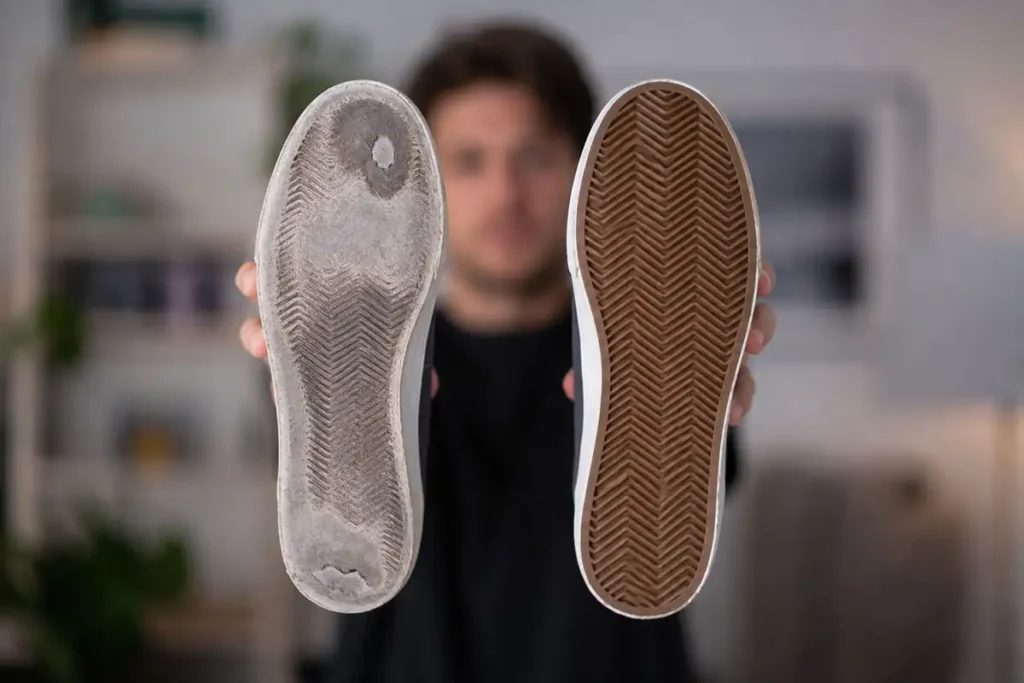
How to read your sole — three forms
1. Wear from the inside → foot inwards (hyperpronation)
If the sole is most heavily spent on the inner side (below the vault and thumb), this is a typical sign hyperpronation — excessive collapse of the inner arch of the foot inwards during the support. At each step, the foot ‘turns over’ inside and the lower leg and knee rotate behind it.
It's not just a cosmetic problem. Excessive (particularly static) detection has been identified in scientific literature as a risk factor for lower limb overstrain, including medial tibial stress syndrome (known as shin splints) (Newman et al., 2013; Neal et al., 2014). Proven foot is associated with a number of biomechanical findings that are regularly seen in runners with this diagnosis.
2. Extinguished from the outside → too rigid foot (supination)
If the sole is consumed predominantly from the outer edge, this may indicate a rigid support pattern or supination. Such a foot is often less burdensome, so contact with a hard surface — concrete, parquet, asphalt — can put a heavy burden on structures above the foot.
3. Left and right sneakers look different → asymmetrically tread
This is the most frequently overlooked pattern, and perhaps the most important. Put both sneakers next to each other and compare them. If the left looks substantially different from the right, your body treads asymmetrically — which may indicate a difference in leg length, pelvic asymmetry or one-sided weakness. Asymmetrical distribution of foot pressure has been documented for example in people with idiopathic scoliosis, where orthopedic insoles can help to distribute forces more evenly (Li et al., 2023).
And here comes the important point: New, expensive sneakers will not solve this problem. It starts "clean", but in a few months it will have exactly the same pattern of wear, because the biomechanics above the sole have not changed.
An analogy that everyone understands: wheel optics
Imagine a car with wheels at the wrong angle. The tyres are not worn evenly — one edge is ‘eaten’ much faster. What would you do? You wouldn't just buy new tires every three months. You'd go to wheel optics and correct the geometry. Only then do the new tyres make sense.
The foot is an important part of the geometry of your body. If it is unfavourable, you can buy a pair of sneakers – you will spend money on ‘tyres’, while the load pattern remains the same. The custom-made orthopedic cartridge has the role of this optics: helps to place the foot in a more functional position to distribute the load more evenly.
Gon tells you there is a problem — but not how big it is
The Đon test is an excellent alarm and starting point, but it is not a diagnosis. The wear pattern shows yes something is not in balance; Doesn't tell you why nor how much. To determine this, an objective measure is needed.
U Ortho Balance Diagnostic Center After interviews and reviews, we conduct digital analysis of the statics and dynamics of walking and running and 3D foot scanning on the latest generation devices. Baropedometric plates show how pressure is distributed in real time, and a 3D scanner gives a precise picture of the shape of the foot. It is only on the basis of this data that we assess whether there is a need for cartridges — and if so, we make them using CAD/CAM technology tailored specifically to your foot. Unlike mass-produced, symmetrical cartridges, this ‘custom made’ approach takes into account the fact that the left and right feet often do not have the same shape or load pattern.
What to do today
You don't have to wait for pain to react. Find the oldest pair of sneakers or shoes you have — the one you wore long enough to have ‘typed in’ your walking pattern — and look at the sole. Where's the most worn out? Is the inner edge, outer edge or heel? Do the left and right look the same?
If you notice a pronounced one-sided pattern or a clear difference between your legs, this is a good reason to look at your feet professionally – especially if you get tired faster, feel discomfort after prolonged standing, walking or training. The problem is not the tire on the sole. The problem is in the biomechanics above it, and it can be evaluated and, when necessary, corrected.
The oldest pair of sneakers you have is more valuable diagnostic information than you think. Look at him before you throw him away.
Take the first step — book an overview
Sources
- Newman P, Witchalls J, Waddington G, Adams R. Risk factors associated with medial tibial stress syndrome in runners: a systematic review and meta-analysis. Open Access Journal of Sports Medicine, 2013;4:229-241.
- Neal BS, Griffiths IB, Dowling GJ, et al. Foot posture as a risk factor for lower limb overuse injury: a systematic review and meta-analysis. Journal of Foot and Ankle Research, 2014;7:55.
- Li Y, Xiaoli H, Ye N, et al. Effect of orthopedic insoles on spinal deformity and walking in adolescents with idiopathic scoliosis. Frontiers in Pediatrics, 2023;11:1259746.
Velibor Viboh, mag. physioth.
Founder and Director of the Medical Body Balance Polyclinic; PhD student at KIF; official physiotherapist of the Croatian Davis Cup national team.